
Case Study
Beyond the Ordinary: Engineering Excellence in Custom Cast-In Heater Manufacturing
No model, no manual, no problem. Tempco technicians recently created a replacement for a severely damaged cast-in heater, skillfully reverse engineering the sample to accurately simulate what it was like when new. Despite having limited information about the original at their disposal, they succeeded on their first try.
Tempco manufactures many cast-in heaters and thermal components with liquid cooling including band heaters, thermal platens, motor housings, feed pipes, ring heaters, barrel heaters, circulation heaters, platen die heaters and complex geometric thermal components (click here for a behind the scenes peek at the manufacturing process). The cast-in thermal components are manufactured with Tempco’s tubular heating elements and aluminum, brass or bronze cast materials. The company’s Cast-In Heater Department has the expertise to develop custom components that will fit any customer’s unique needs
Tempco was contacted with this challenge by Process Engineering Products, a distributor Tempco has collaborated with on several past projects, on behalf of an end user. The original casting was mounted on a pipe system that fed molten material into an extruder, keeping it hot as it flowed so it wouldn’t solidify in the tube. However, given the poor condition of the sample, it was clear from the start that designing the new casting would not be simple.
“Usually when the customer sends their casting in to us, we can easily reverse engineer to design our own version, but the castings that we received were very warped due to melting and being dropped on the ground during many years of use,” said Christian, a design engineer with the Cast-In Heater Department.

Split-ring clamp industrial component with circular bore and mounting tabs.
Partnership Yields Progress
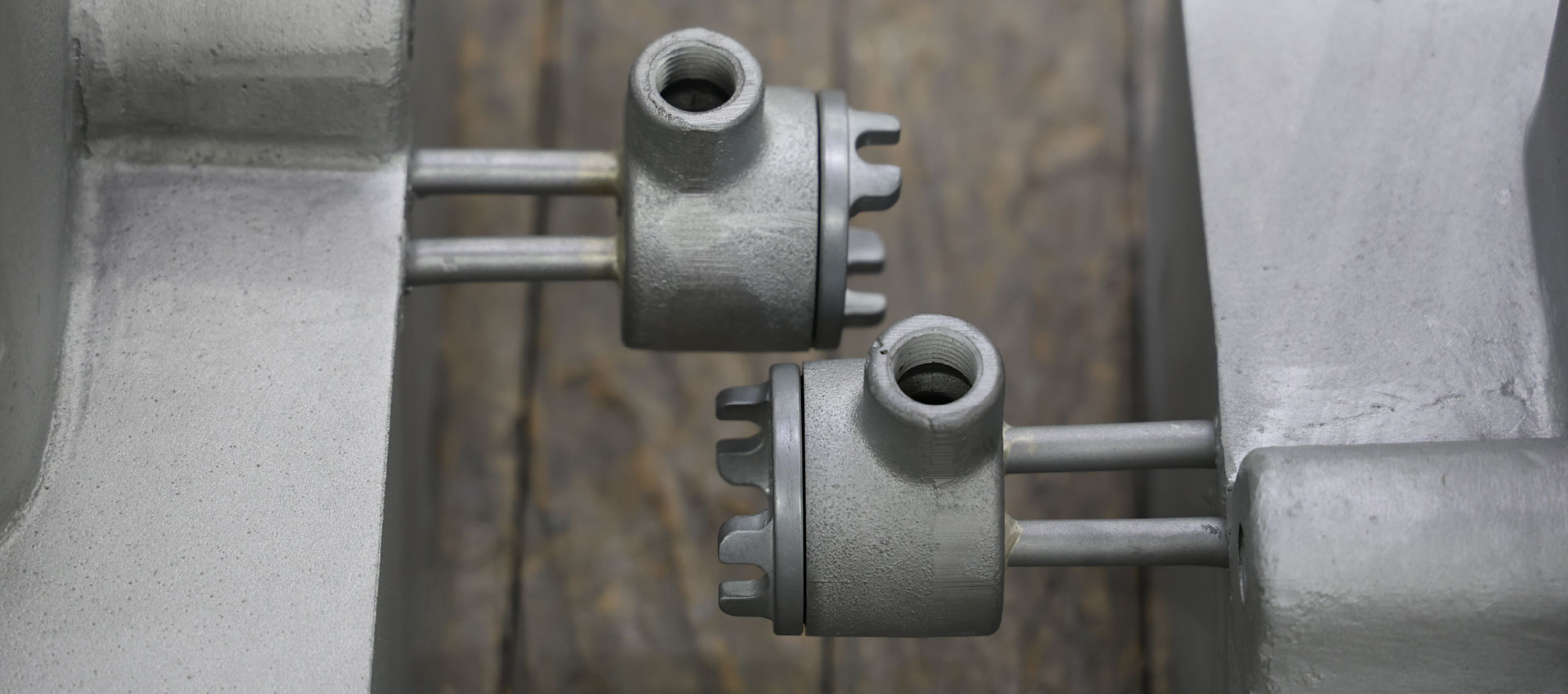
Close-up shot highlighting threaded connections, mounting hardware and precision-machined surfaces on custom cast-in heaters.
Christian first received the sample in December and took it back to his desk for initial physical measurements. It became clear quickly that he’d need additional information to make the project a success.
He relayed his questions to Process Engineering, which visited the customer’s plant and inspected the machine it was attached to. Their team was able to provide drawings and notes on details such as the size of the space the heater occupied and the clearance it needed from parts around it. In the absence of any technical documentation for the machine, Christian credited Process Engineering’s assistance as instrumental to the project.
With the new details in hand, Christian set out to design a new molding using 3D modeling software. Based on what was learned, Tempco proposed to modify the shape of the casting to ease aspects of the production process, such as element setting, and worked with Process Engineering to get the customer’s approval.

Custom cast-in heater unit with split-body design and base mounting system.
No Room for Error
The size of the casting made it important to get the design right on the first try. Christian estimated the customer sample weighed over 100 pounds and was nearly 3 feet long, 22 inches wide, and 8 inches high. It was sitting in an extender box that added another 10 inches of height, bringing it to about 18 inches in total.
“It was awkward to handle because all of the weight was distributed all over the piece and there weren’t any good handling or gripping points on it,” Christian said.
The team moved ahead to manufacturing by March, using an aluminum casting with steel heating elements inside. Its bulk added complexity when the team needed to prep the casting for machining, grinding imperfections and removing risers. New long tooling was required for all of the bolt holes and the tapped hole by the elements to avoid collisions. The clamping holes needed to be exact to ensure the boring operations went smoothly.
“We managed to hit our mark on the first try and the rest of the machining went without issue,” Christian said. “The shipping department treated the casting like any other and put it on a pallet with foam inside of a box to prevent damage. They had no issues related to weight or shape.”
A Trusted Leader in Custom Cast-In Solutions
Tempco’s success with challenging jobs like these has bolstered its reputation as an innovator and reliable partner manufacturing custom cast-in heaters. Tempco has robust capabilities for producing custom cast-in heaters using aluminum, bronze or brass alloys (click here to learn about the strengths of each alloy).
The company’s in‑house foundry supports permanent‑mold, low‑pressure and no‑bake sand casting, achieving cast component weights from under 150 pounds (typical for platens and semiconductors) and up to 600 pounds for larger sand‑molded or tilt‑pour components. Cylindrical cast‑in band heaters span 1″ to 48″ inside diameter and up to 60″ wide (or 40″ length, 72″ for platens) and support up to 600 pounds in aluminum or 300 pounds for bronze and brass.
Tempco offers both air‑cooled (finned) and liquid‑cooled versions, with various tubing diameters, dual circuits for enhanced durability, and standard surface finish of 125 RMS, with custom finishes and treatments like anodizing, nickel plating, Teflon®, or hard‑coat anodizing.
In short, Tempco has full-service engineering and manufacturing capacity, with extensive customization options, geometric flexibility, and the capacity to produce substantial, complex cast-in heaters up to several hundred pounds tailored to customer specifications. Click here to learn more in the cast-in heaters pages of Tempco’s catalog.
Have a challenging thermal component project? Contact Tempco’s engineering team today.
