
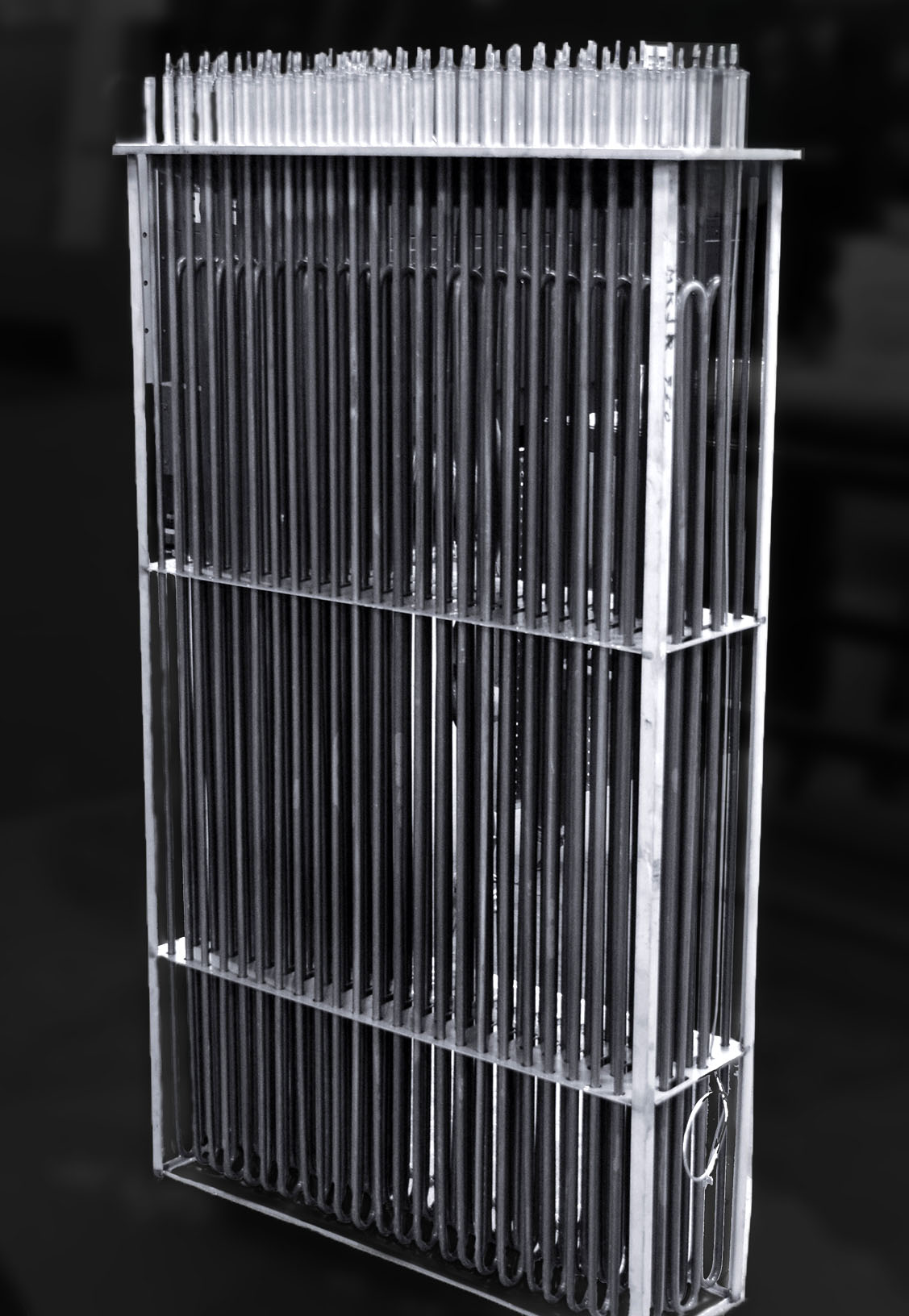
A customer approached Tempco in need of a high-wattage heating solution for a battery electrode manufacturing application. In addition to the high wattage, the customer’s request included additional specialty requirements. Tempco designed multiple iterations of heaters to implement at different zones of the customer’s manufacturing process. One of the larger designs consisted of a 53” housing length operating at 400KW with a 4” custom insulation box.
- Initial designs: Over 100 tubular elements, requiring too much welding for the standard hairpin bend formation.
- Solution: Tempco used a more specialized bend formation.
- Reduced the total number of elements by over 30%.
- Fewer elements led to:
- Decreased failure points
- Lower overall cost
- Simplified assembly complexity
- More effective and cost-saving design
 Ensuring No Free Iron in the Airstream
One of the other major challenges in designing these tubular duct heaters was meeting the requirement that absolutely no free iron could enter the application airstream. Special care was taken when filling the insulation box to guarantee that no additional foreign matter would encounter in the flow stream. Additionally, to keep iron out of the airstream, the tubular heating elements in these designs needed to be passivated.
Passivation: A Crucial Step in Preventing Contamination
Passivation is the process of treating or coating a metal to reduce the chemical reactivity of its surface. In stainless steel, passivation means removing the free iron from the surface of the metal using an acid solution to prevent rust. Since the air from these duct heaters would be encountering lithium used in batteries, any free iron on the elements could mix with the lithium and cause failures.
Most companies can’t perform passivation on such long heaters due to their tank immersion depth limitations (usually 40” to 45”). However, due to the large nature of these designs, Tempco developed a custom passivation tank with the proper immersion length for the elements. This acidic reservoir was able to fit each design and treat the free iron on the surface of the elements. The custom-built passivation tank effectively fit the largest design, which consisted of a 60” direct immersion length. After immersion, the heaters were allowed to dry, then rinsed and tested per ASTM standard. Finally, the elements were protected to avoid further contamination.
Final Heater Performance and Precision Control
The final heaters proved to work well for this heating application. They were able to heat a fast-moving flow rate of air (around 6,000 cubic feet per minute) by 100°F as it passed over the elements. Several custom thermocouples were also attached to the tubular elements and placed near the outflow of air to allow for more precise control, while preventing overheating.
If you’re looking for a reliable, custom heating solution for your manufacturing process, Tempco can help. Our team is ready to design and implement the perfect system tailored to your unique needs.
We’ll help optimize your heating requirements with innovative, cost-effective solutions.
Let’s work together to create the ideal system for your application!